Want to send across rewards and incentives in just a few clicks?
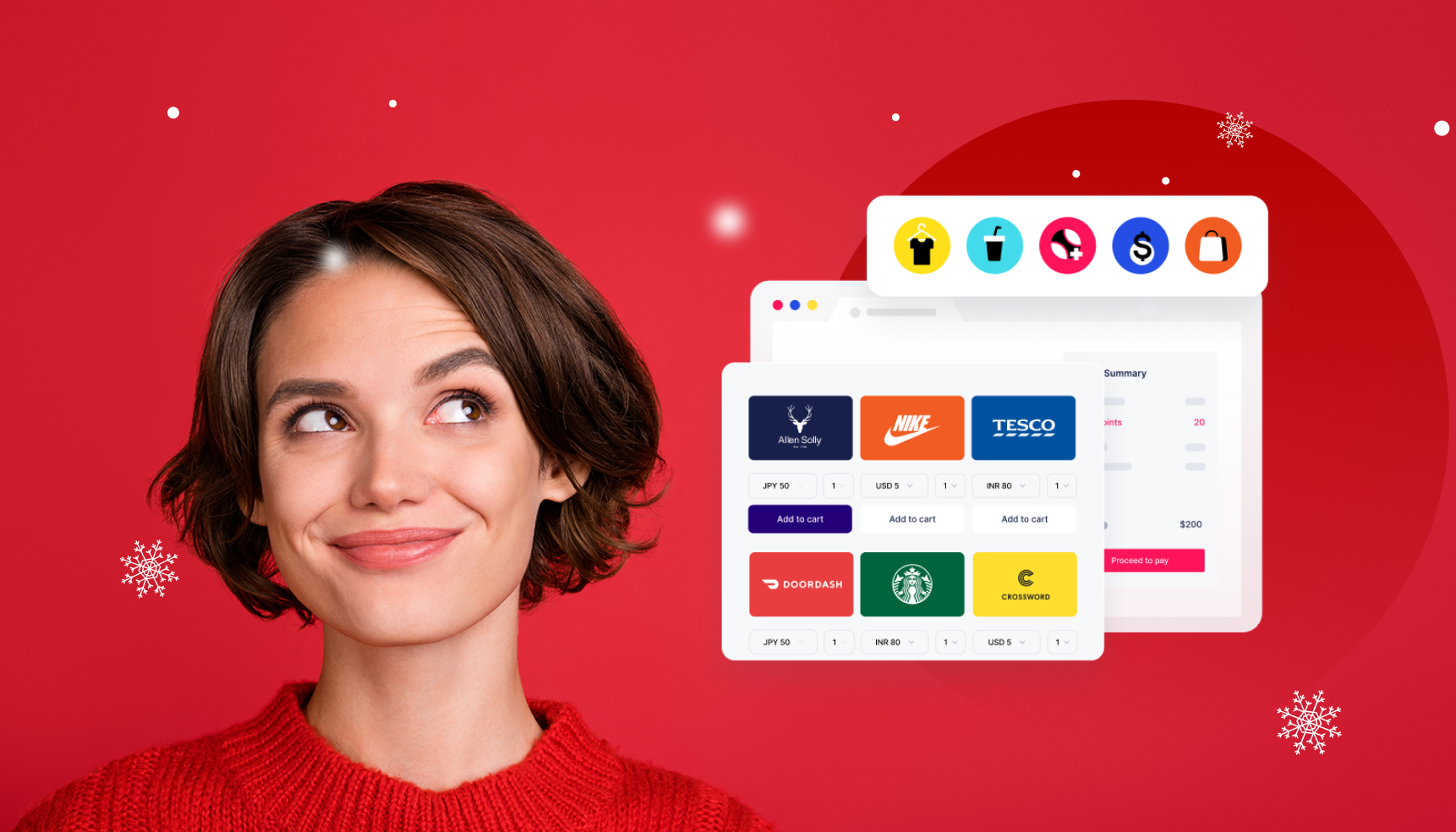
Join Plum to drive behaviors that power business results, with rewards and incentives made simple. Choose from the widest global catalogue of 20,000+ gift cards, perks, experiences, merchandise and benefits. Submit a request to see our platform in action right away!
How to Setup Customer Incentive Programs: A Beginner’s Guide
Nothing feels more ‘right’ than gaining more and more (and more) customers, right? Well, a well-planned customer incentive program can help you achieve precisely that!
That shot of happiness that courses through your veins everytime you tuck into a cup of Starbucks? It could be more than just caffeine. After all, the ‘rewards’ you pick up with every sip can produce an equally heady feeling. That nearly 50% of mobile users who use restaurant loyalty apps use Starbucks Rewards (the name of its customer rewards program) is proof.
Starbucks doesn’t just stop there, of course. Members of their Loyalty Program get free games and music all year (the kind they dig!). They can hoard rewards and redeem them whenever they want. They can also share or gift their points to love ones. And the breezy app? It’s just a joy to use.
American Express also rewards ‘sticky’ users of its cards generously, going an extra mile by creating an exclusive community for members. Air Miles, on its part, makes its loyal patrons smile by partnering with popular brands, and offering reward points that can be redeemed across partner stores.
What’s common here? Each of the above is a carefully put together strategy that honours attachment, respects individuality and delights innovatively. In other words, each of the above is an example of what the trade calls a ‘Customer Incentive Program’. And here are a few figures why not just customers, but businesses too, can’t have enough of them.
58.7% of internet users believe earning rewards and loyalty points is one of the most valued aspects of the shopping experience.
Customer Incentive Programs: A Quick 101
Brands and organizations run Customer Incentive Programs to gratify and reward customers and fans for performing (and often, repeating) certain pre-defined behaviours or actions that are beneficial to the brand and the business. Some of those behaviours could be making a purchase, writing a review or referring a potential customer. The benefits of a Customer Incentive Plan can vary - from generating a spike in sales to building conversations and awareness in the social domain to deepening brand attachment with customers (both existing and new). No matter why you want to consider running a Customer Incentive Plan, you probably won’t walk away disappointed. After all, a Customer Incentive Plan is a tested way to drive some of business’ most important KPI’s, and be one of your most powerful and consistent competitive edge.
Behaviours That are Usually Incentivized by Business
Organizations classify various kinds of actions and behaviours as ‘reward-worthy’, depending largely upon the goals the business is trying to achieve with the incentive program, the personality of the brand, and the profile of the user or buyer. Some common behaviours that incentive programs tend to recognize and reward are :
Making a purchase.
Upgrading a plan.
Referring someone to the business.
Writing a review for the brand.
Sharing UGC (User-Generated-Content) on the company’s online pages.
Customer Incentives Ideas
Be it cash or non-monetary, brands today have the liberty and choice of picking and choosing from a wide range of reward-worthy items. The nature of the reward, at the end of the day, is a result of multiple factors : From the image the brand has in the minds of its markets, to the magnitude of the occasion to the personality and preferences of the recipient and others. Here are some popular rewards genres and categories…
Deals & Cash backs.
Coupons and Discounts.
Branded currencies & vouchers.
Merchandize.
Free samples.
Free upgrades.
Memberships.
Brand experiences.
Store credits.
Gifts & mementos.
Customer Incentive Program Ideas
Need an Incentive to Run a Customer Incentive Program? Here are 6! Let’s look at the various benefits a Customer Incentive Program can deliver for a business or brand, irrespective of niche, goal or growth stage.
1. Lifting both revenue and morale - By boosting sales
This is an obvious and straight forward one. Barring exceptions like essential goods and services that don’t have a comparable substitute, incentivizing someone to buy your product will - in most cases – lead to a higher percentage of response than if you didn’t offer a reward. Be it clearing inventory backlogs, pumping up a sagging morale or taking your revenue to the next level, a boost in sales figures ticks a long list of boxes.
According to fundera.com, customer incentive program members spend 12-18% more annually.
As per sloanreview.mit.edu, participants of leading customer incentive programs are 77% likely to choose your brand over a rival.
sloanreview.mit.edu also confirms that buyers who are part of a customer incentive program are 117% more inclined to recommend the brand to others.
2. Baking-in the 'Return Business' by Building Loyalty.
The Pareto Principle states 80% of your profits come from just 20% of customers.
Being appreciated for their patronage makes customers feel good and draws them closer to the brand, deepening the emotional connect they have with it. The effects of loyalty are both exponential and non-linear, often benefitting your brand in unexpected ways. For one thing, loyal customers will stay with you through thick and thin, helping you outlast rough times. They will, of course, keep bringing in repeat business. And finally, they will happily play the role of your company’s cheerleaders by spreading brand-love on social channels, online groups and public forums – making you look good where it matters.
75% of consumers say they are likely to make another purchase after receiving an incentive.
69% of consumers say choice of retailer is influenced by where they can earn customer loyalty/rewards program points.
40% to 65% of a company’s business comes from existing customers.
43% of customers spend more money on brands they’re loyal to.
It costs 5 times more to acquire a new customer than it does to retain a returning one.
Lowering your customer churn rate by 5% can increase your profitability by 25 to 125%.
3. Refining Marketing Initiative with Better Data.
87% of Americans are willing to have various details of their activity tracked in exchange for more personalized rewards and brand experiences.
A customer incentive program is a great way to collect data about your customers. Buyers are far more open to sharing personal information when there’s a carrot at the end of the stick. In today’s age, data is the surest way to businesses’ Holy Grail of ‘Happy Customers’. It gives you a better grip over the buying habits, lifestyle and preferences of your target demographics, and lets you continuously test, refine and optimize both your marketing campaigns and user experience.
Digital marketing guru Neil Patel chips in with this eye-opener:
A McKinsey study found that “executive teams that make extensive use of customer data analytics across all business decisions see a 126% profit improvement over companies that don’t.”
4. Touching them where it matters: in the heart.
Connecting with customers emotionally can lead to rich dividends for brands over both the short and long term. For companies they can relate to, buyers are willing to pay more, double up as vociferous brand ambassadors (saying good things about it to everyone and their neighbour), and stay loyal. The irony is that most brands don’t quite ‘get it’, and 68% of customers continue to leave because they feel the company doesn’t care about them. Customer incentive programs that have the vision and gumption to rise above the merely transactional can turn this table by leveraging brand traits and values-pillars to build meaningful relationships with their fans and patrons. We will look into the ‘Exactly How’ a little later in this article, but for now, here’s casting a glance at the impact of emotion in business:
HBR says….
A major bank witnessed a 70% increase in ‘use amongst segment’ and a 40% spike in new account growth after introducing a credit card for Millennials that was designed to inspire emotional connection.
A leading household cleaner converted market share losses into double-digit growth within a year of launching products and messaging that were designed to maximize emotional connection.
A US apparel retailer experienced 3X growth in same-store sales after reorienting its merchandising and customer experience to its most emotionally connected customer segments.
5. Building Positive PR Buzz
“Your brand isn’t what you say it is - it’s what Google says it is” : Chris Anderson, Head of TED.
Chris, while being dramatic, merely underlined what is a fact. That reviews, ratings and user generated feedback / content (UGC) ranks right up there when it comes to generating - or ‘fixing’ - an organization’s online reputation. After all, your buyers trust what friends, peers and actual users have to say about your brand, considerably more than the messages your brand directly puts out (this may hurt, but denial-mode can be worse). Of course, this is dicey territory, and reviews can go either way. This is where customer incentive programs come in. Done right, they can tilt the balance in your favour, and are a proven way to generate positive customer feedback, thus making a brand shine brighter in public.
The dope on ‘user generated content’…
91% of people read online reviews, and 89% of folks compare them with recommendations from friends.
85%of consumers trust customer reviews just as much as they trust personal recommendations.
Over 70% buyers will recommend a brand if it has a sound loyalty program.
31% of consumers say they read more reviews in 2020 because of Covid-19.
72% of US consumers had written a review for a local business in 2020 - a big jump from 66% in 2019.
An expertly planned customer incentive program also ties-in snugly to your referral marketing strategy – which is the practise of having happy customers recommend your brand to friends and acquaintances. Referrals happen to be an extremely High ROI marketing approach, for two reasons. One, the cost of new customer acquisition is nearly zero. Two, since the 'Referrer' is familiar with both your brand and the person s/he is referring, both buying intent and chances of conversion are high. You will experience the benefits first-hand when you do customer incentivization right.
Someone referred by a friend are 4X more likely to buy.
B2B companies with referrals experience a 70% higher conversion rate.
The lifetime value (LTV) of a customer who has come in through referrals is 16% higher than that of non-referred customers.
Referral leads carry a 30% higher conversion rate than leads generated by any other channel.
Referrals account for 65% of companies’ new deals.
Customer Incentive Programs Best Practices
Let’s look at the essentials and elements of a powerful Customer Incentive Program, along with some strategies, approaches and tips that can help fine-tune nuts & bolts to ensure that the outcome is close to expectations.
1. First Things First: Figure out the Real Reason (s) Your Business Needs A Customer Incentive Program.
It is tempting to rationalize your customer incentive program with the logic that it will boost sales and bring in revenue. Who could argue with that, right? Well, at least one person from every functional area and department should. That’s because the very need for a customer incentive program can often (though not always) conceal deep-seated cracks within the organization. Are you losing customers to rivals? Why are long time buyers suddenly behaving strange? Could there be bottlenecks in processes and systems? Are Sales folks demotivated? Is the strategy missing a vital point or two? Is the leadership disengaged? A customer incentive program – apart from making the cash registers jingle – offers a great opportunity to diagnose and decode what’s amiss along your AIDA funnel, and reset the fundamentals.
2. Be Clear on the Objectives
While getting a short time spike in sales and revenue is the most obvious and common reason why organizations opt for a customer incentive program (and there’s nothing wrong with that), stopping there would be lazy. That’s because taking a deep dive - data and analytics in tow – can help you identify gaps and weak-links in your AIDA chain, CRM journey and buyer funnel. You can then take the necessary corrective steps and actions to make your customer incentive program truly efficient and impactful. Undertaking this exercise will also make it easy to figure out the real KPI’s and goals you must focus on for your customer incentive exercise - be it…
Acquiring buyer data
Getting feedback for a trial or launch
Boosting online PR and goodwill (via reviews and UGC)
Getting folks to ‘opt-in’ for your newsletter or mailers
Hike up sales.
3. Target the Right People
A customer incentive program that means everything to everyone doesn’t usually mean a lot for the business. That’s because it spreads itself too thin to have a meaningful connect with a specific group of people or any one particular demographic. In the process, you miss out on the opportunity of getting the best bang out of the buck, time, effort and manpower you invest. Do you want to bring your once-loyal customers to return? Are you looking to tap new markets and audiences? Does targeting only VIP and HNI (High Net Worth) clients make the most sense to your current business situation? Figuring out WHAT you want to achieve will make your program more easy to implement, efficient and productive.
4. Bake in the 'Meaning'
While there will be many customers who will respond to your campaign with the ‘right behaviour’ (be it writing a review, sharing personal information or making a purchase), they will also ‘move on’ immediately, without nurturing any recall for the experience. That happens when the activity is designed purely as a clinical and transactional one. Instead, make the experience meaningful and significant - so that participants take away a memory they will cherish, share with their communities and networks, and possibly return for. Here are some ways to do that…
Design the customer incentive program in line with the brand persona your markets identify you with.
Deploy the program in keeping with the character and values your fans know you by.
Add transparency by being open and frank about the purpose of your program.
Make them feel important : Invite folks to walk a mile in your shoes by narrating the need for it at this specific point in time – and soliciting their views and advice on how best to go about it.
Express your gratitude to anyone who takes the time out to enrol for the program (yes, even if they have a ‘commercial motive’ for doing so).
Build in the purpose (the ‘WHY’) by attaching the activity to a community aspiration, global goal or CSR cause.
Align the reward to the spirit and occasion. This is a big one, so let’s look into this aspect in greater detail in the next paragraph.
5. Plan Incentives Inuitively arount the Princiles of Scientific Reward Design
Your audiences and fans probably come across several brand campaigns and messaging luring them to participate in a sweepstakes or contest in exchange for a ‘cool goodie’, or urging them to make a purchase against a prize. Given their limited time and attention span, how do you fire their imagination and stand out from the competition? The trick lies in a great ‘Reward Design’. This is the X-Factor that can upset all calculation - from common sense to ‘data driven business intelligence’, and turn the equation in your favour. Reward Design is a concept most organizations ignore or underestimate, and end up paying the price.
Here are the pillars of an intuitive Reward Design that can measurably enhance the goals you have set for your customer incentive program.
Reward Design Principle #1: Desirability
Make sure your incentives and rewards are trending and desirable, and feature on top of your participants’ Wish-Lists.
Reward Design Principle #2: Customization
Make the incentive personal and meaningful. Match it to the spirit and magnitude of the occasion, as well as the personality and background of the receiver (if you have solid persona data, this is the time to use it). For instance, if you are approaching doctors pursuing medical research, your reward bounty should be qualitatively different from that of a target audience whose members are primarily kids and single-mindedly interested in candy. Similarly, the incentives you will plan for College Freshers will look and feel very different from the one you will offer to CXO’s and senior industry leaders.
Reward Design Principle #3: Speed
An incentive delayed is an incentive denied. So make sure you cut out the time-lag and share the reward instantly. You can also schedule Pre-Paid incentives which, as per studies, can also be high effective - especially for surveys.
Reward Design Principle #4: Convenience
Go tech with rewards to smoothen the process. Xoxoday PLUM, for instance, can be easily integrated with your organizational tech processes as well as your Feedback infrastructure, and deployed from Day One over a Plug-and-Play format.
Reward Design Principle #5: Choice
Give your participants the freedom to choose their reward. SaaS platforms make it easy to do that. PLUM, for example, offers a comprehensive ‘global catalog’ of perks, discounts, vouchers, branded currencies, merchandize, benefits, gifts and experiences covering every possible niche and interest area such as e-commerce, utilities, recharges, groceries, books, gadgets, wellness, learning, fashion & wearables, entertainment, dining, travel, cash / prepaid cards and much more – all of which are redeemable in any country.
Should you go for Cash or Non-Cash for Rewards?
While the appeal of cash is universal, timeless and well documented (making it a safe choice of reward for customers and potential buyers), research confirms that non-monetary rewards can rank even higher for certain groups of people. The difference can sometimes be significant. Trends also show that non-cash ‘benefits’ are cherished across age groups - and particularly by Millennials and Gen-Z. In other words, when that Mastercard ad on TV proclaims philosophically that there are some things money just can’t buy, it isn’t joking. And what about that endless debate between cash incentives and the non-cash kind? Which one should you go for? Well, the decision will depend on your understanding of your target demographic persona. When in doubt, it’s best to go for a blend of both – and A/B test your campaign by trying different ratios and combinations. Read up more on cash vs non-cash incentives.
Give Your Customer Incentive Programs The Edge of New Digital Tools
In an age of increasing competition and expectation, digital solutions can give your customer incentive programs the sophistication, efficiency and speed you need. More so, if you are used to managing your marketing programs manually, which can led to human error, loss of time and drainage of manpower.
Automate your Rewards Framework with Technology.
For leaders, the digital way to motivate, engage and applaud the customer opens up whole new horizons in speed, personalization and efficiency. Xoxoday’s PLUM is a case in point :
PLUM is easy to implement, integrating effortlessly with your current technologies and systems like CRM, HRMS, PRM, Surveys and more.
Apart from breezy customizability and deep personalization, PLUM’s omni-channel nature makes it compatible with any delivery medium your systems are comfortable with, such as On-Screen, SMS, Email, Whatsapp, QR Codes, Notifications and several others.
Finally, PLUM’s data-rich reports and analytics bring you never-before visibility and insights into every aspect of your incentive ecosystem (usage patterns, spending patterns, ROI) so that you can keep optimizing and improving it.
3 Take-Always as you Get Your Customer Incentive Program on the Road...
1. Prioritize and Focus.
On your customer, not your competition. Remember, you are ultimately trying to build a relationship your customers will cherish, not win a race your patrons don’t care about. Keep their needs front & centre, make sure the rules of engagement are simple to understand, reward at multiple levels, bake-in the right blend of intrinsic and extrinsic motivation while designing your rewards stack and tweak the program as-you-go to accommodate shifts in your customers’ moods and tastes.
2. Get Inventive with Tech.
Create easy, enriching and seamless moments for your customers with a great UX design – one that’s a pleasure to use and return to. Design ‘entry points’ and ‘onboarding bays’ at multiple touchpoints along the engagement journey, making it easy for them to join the program at any point of the loop.
3. Promote Innovatively.
Make sure your customer incentive program reaches the maximum number of relevant eyeballs. Start with a great name, build pre-event buzz with teaser messaging, set emailer reminders as launch day advances, reach out via one-on-one messaging, go multi-channel to engage customers on their favourite platforms, explore the possibility of co-branding and tie-ups with brands who share a similar cause and connect with your customers and stay top of mind with compelling storification.
 SCHEDULE A DEMO NOW